
Clinical workflow design
Why paper voiding diaries fail: a urologist's case for structured digital intake
Dr. Christian Diab · May 6, 2026 · 5 min read
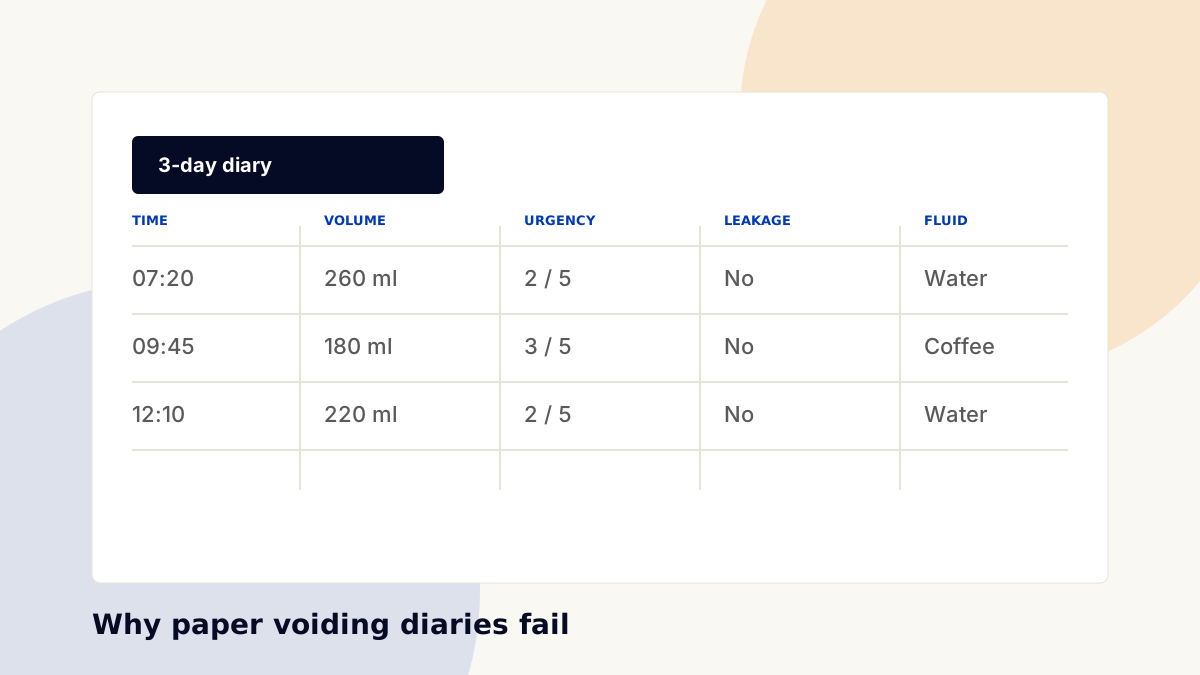
Every urology clinic has a stack of them. Preprinted three-day bladder diaries, columns for time, volume, urgency, leakage, fluid intake. We hand them to the patient at the first visit, explain the instructions, circle the start date, and ask them to bring the completed diary back at the follow-up.
Somewhere around five percent of those diaries come back complete.
That number is not a comment on patients. It's a comment on the tool we've been asking them to use.
Why the diary matters
For a urologist evaluating lower urinary tract symptoms, the three-day diary is arguably the single most valuable piece of history we can get. A patient can tell me, in words, that they "go often" or "leak sometimes." Those words are clinically meaningful, but "often" is not a number, and a number is what I need to reason about nocturnal polyuria, functional bladder capacity, and the relationship between urgency and leakage.
When the diary works, the visit is transformed. We move from twenty minutes of partially-remembered symptoms to a structured conversation anchored in three days of objective data. When it doesn't — which is most of the time — we improvise, estimate, and often book the patient back because the data we needed never arrived.
Five ways a paper diary fails
1. The diary is handed over without a plausible plan to start. A patient leaves a busy clinic with a folded sheet and a vague intention to "start on Monday." By Monday, the paper is in a drawer. By the follow-up, it is either missing, started on the wrong day, or filled in from memory — the worst outcome, because it reads as data but is recall.
2. The entry burden is too high. Noting the time, estimating volume, rating urgency, and flagging leakage, eight to twelve times a day, honestly and in the moment, is a real cognitive load. Patients skip entries, batch them at day's end, or quit after day one.
3. Free text destroys structure. Paper invites creative answers. "A lot" in the volume column. "Big" in the leakage column. "Tea" in the fluid column, when the clinical relevance is caffeine content that "tea" does not disambiguate. Free text is how clinical signal becomes clinical noise.
4. There is no reminder. The paper diary has no way to nudge the patient at 8pm on day two. It sits on the kitchen counter. Willingness to use it becomes a function of memory and routine, neither of which we engineered.
5. Legibility is invisible until the follow-up. The first moment anyone knows the diary is unusable is when the patient sits down across from me. At that point the visit is running, and there is no earlier feedback loop.
None of these are exotic. They are the predictable outcome of asking a patient to perform a structured data-collection task with an unstructured, offline, no-feedback instrument.
"Structured" is not the same as "digital"
The first instinct is to move the diary to a phone. That is necessary, but not sufficient. I have seen PDF diaries emailed to patients, online forms that accept any string, and portals where the diary is a free-text box labeled Please record your voiding pattern. Those are digital diaries. They are not structured diaries. They preserve the same failure modes, in a browser.
A structured diary is one where every field is either a number or an enumerated choice, valid ranges are enforced at the point of entry, and the interface guides the patient through a single entry at a time rather than presenting a grid to be filled. Volume is numeric with sensible bounds, not a text box. Fluid type is a short enumerated list — water, coffee or tea, alcohol, carbonated, other — not a write-in. Urgency is a five-point scale, not an adjective.
The structure matters because it is what the clinician reads at the other end. Enumerated fields aggregate. They compare across visits. They produce a completeness score that tells me, before I walk into the room, how much confidence to place in what the patient reported.
What completion actually changes
Moving the baseline from roughly five percent to twenty-five percent is a deliberately modest target. We have not proven it yet, and anyone promising a dramatic leap is speculating. But even that modest move changes the visit meaningfully.
At five percent, the diary is essentially not part of the workflow. At twenty-five percent, it is sometimes part of the workflow — and when it is, the visit is better. The interview becomes shorter and more focused. Supplementary tests are ordered more selectively. The patient feels, often for the first time, that the thing they were asked to do actually mattered to what happened next. That last point is underrated as a driver of future adherence.
A diary built for completion sets expectations up front, reminds patients at the right moments without guilt, accepts partial days as partial rather than losing them entirely, shows progress, and hands back a copy of what was submitted. The diary was always supposed to be theirs. We just never had a way to give it back to them.
The downstream effect is simple: when the data arriving at the clinician is clean and consistent, the clinician's time shifts from reconstructing data to practising medicine. History-taking gets shorter — not because we've automated anyone's judgment, but because the patient has already done the structured part, in their own time, using an instrument built for it.
What comes back in the visit is the part of medicine that cannot be captured in a form: the conversation, the exam, the explanation, the plan. The part that is actually the reason the patient came.
Better data, for more human care. In practice, the two are not opposed. They are the same project.
Dr. Christian Diab is the Medical Director and co-founder of CuraDia, a Québec medtech company building Uro-OS — the clinical operating system for urology and pelvic medicine. Uro-OS pilot onboarding is planned for Q3-Q4 2026 with Service d'Urologie Rive-Sud.